
When you use ion exchange in chromatography, you rely on charged resin beads that grab ions from your sample based on their electrical charge Cation analysis. This selective binding lets you separate ions as they pass through the column, but it’s not just about charge—factors like ion size and the mobile phase conditions play crucial roles. Understanding these interactions helps you fine-tune your separation, yet the details of how you adjust these variables can make all the difference.
How Ion Exchange Resins Separate Ions in Chromatography
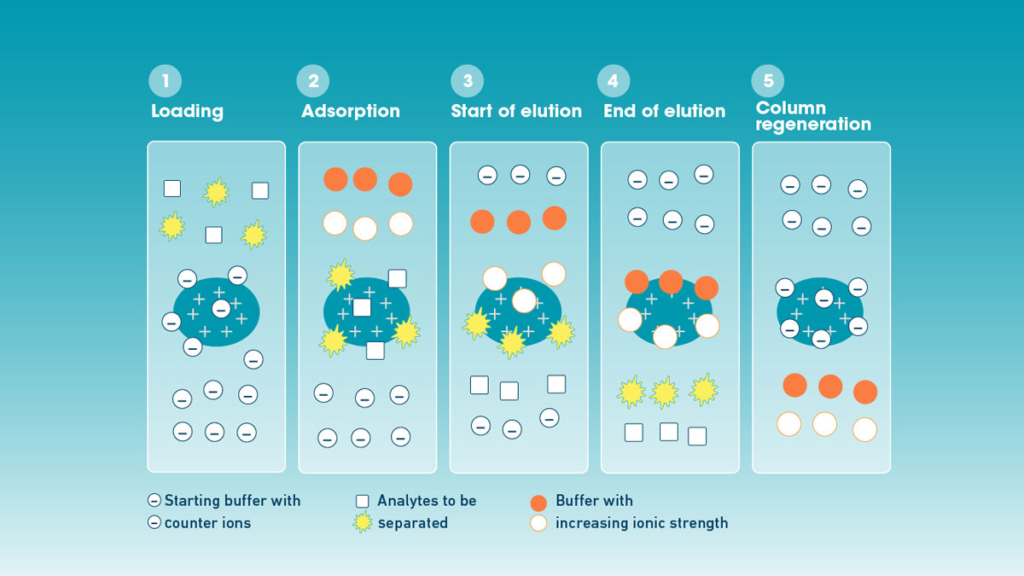
Ion exchange resins separate ions in chromatography by selectively binding charged particles based on their affinity to the resin’s functional groups.
When you pass a mixture through the resin-packed column Lab Alliance, ions with a stronger attraction stick to the resin, while others flow through freely. This selective adherence lets you isolate specific ions from complex samples effortlessly.
You control the process by adjusting conditions like the mobile phase or flow rate, giving you the freedom to tailor separations to your needs.
The resin’s charged sites act like magnets, grabbing ions opposite in charge, then releasing them when conditions change. This dynamic interaction means you’re not just separating ions—you’re mastering their movement, unlocking precise control over your analysis and letting you explore the freedom of targeted ion separation.
Why Charge and Affinity Determine Ion Exchange Selectivity
Understanding how ions interact with the resin’s charged sites helps explain why some stick while others pass through.
You’ll find that ions with higher charges tend to bind more strongly because the electrostatic attraction is stronger. For example, a divalent ion will generally have a greater affinity for the resin than a monovalent ion.
But charge isn’t everything—affinity depends on how well the ion’s size, hydration, and chemical nature fit with the resin’s structure.
You can think of it like a lock and key: the better the fit, the stronger the interaction.
This selective binding lets you separate ions effectively, giving you control and freedom to target specific ions based on their charge and affinity without unnecessary interference.
How Mobile Phase Conditions Affect Ion Exchange Efficiency
When you adjust the mobile phase conditions, you directly influence how efficiently ions exchange with the resin.
Factors like pH, ionic strength, and temperature shape ion interactions and resin behavior. For example, changing pH affects ion charge states, altering their affinity for the resin and shifting retention times.
Increasing ionic strength competes with target ions, potentially speeding up elution but reducing resolution.
Temperature tweaks can enhance ion mobility, improving exchange rates but might also impact resin stability.
By controlling these variables, you gain freedom to fine-tune separation efficiency without compromising your system’s integrity.
Understanding this balance lets you actively shape the chromatographic process, ensuring you get the results you want without being limited by rigid conditions.
Techniques to Optimize Ion Exchange for Better Chromatographic Resolution
Boosting chromatographic resolution often hinges on how well you optimize ion exchange conditions. Start by selecting the right resin type and particle size to match your target ions; smaller particles generally improve resolution but may increase backpressure.
Adjust the mobile phase’s pH and ionic strength carefully—this controls ion exchange capacity and selectivity, letting you separate closely related species. You can also fine-tune flow rates; slower flows enhance interaction time, sharpening separation.
Don’t overlook temperature control, as it influences ion mobility and resin behavior. Finally, consider gradient elution profiles to gradually change ionic strength, improving peak resolution without sacrificing speed. By mastering these techniques, you gain the freedom to tailor your ion exchange system for precise, high-quality separations every time.
Common Applications of Ion Exchange in Ion Chromatographic Analysis
Optimizing ion exchange conditions sets the stage for applying ion chromatography across various fields.
You can rely on ion exchange to separate and analyze ions in environmental monitoring, ensuring water quality by detecting contaminants like nitrates and heavy metals.
In pharmaceuticals, it helps you verify drug purity and detect impurities, maintaining safety and efficacy.
Food and beverage industries count on it to monitor additives and preservatives, keeping products safe.
You’ll also find ion exchange useful in chemical manufacturing, where it aids in quality control and process optimization.
Conclusion
You’ve seen how ion exchange resins separate ions by using charged groups that attract opposite ions with varying strengths. By understanding how charge and affinity influence selectivity, you can adjust mobile phase conditions like pH and ionic strength to fine-tune your separation. With the right optimization techniques, you’ll improve resolution and efficiency in ion chromatography, making it a powerful tool for analyzing complex mixtures in various applications. Keep these principles in mind to get the best results.